

Why D-Motion Machines Are Transforming Indian Packaging in 2026
India’s packaging industry crossed ₹3.7 lakh crore in market size in 2025, and it is growing at over 13% annually. At the center of this growth is one critical shift: manufacturers are moving away from traditional stop-start FFS machines toward continuous-motion technology — and D-Motion Type Packaging Machines are leading that transition.
Whether you run a spice unit in Rajasthan, a snack brand in Gujarat, or a grain packaging facility in Punjab, the D-Motion Type Packaging Machine is increasingly becoming the equipment of choice. But with prices ranging from ₹3.5 lakh to ₹12 lakh and beyond, choosing the wrong model can cost you far more than the machine itself.
This guide gives you everything you need: accurate pricing, feature breakdowns, honest comparisons, and a decision framework built from real industry experience — so you invest in the right machine the first time.
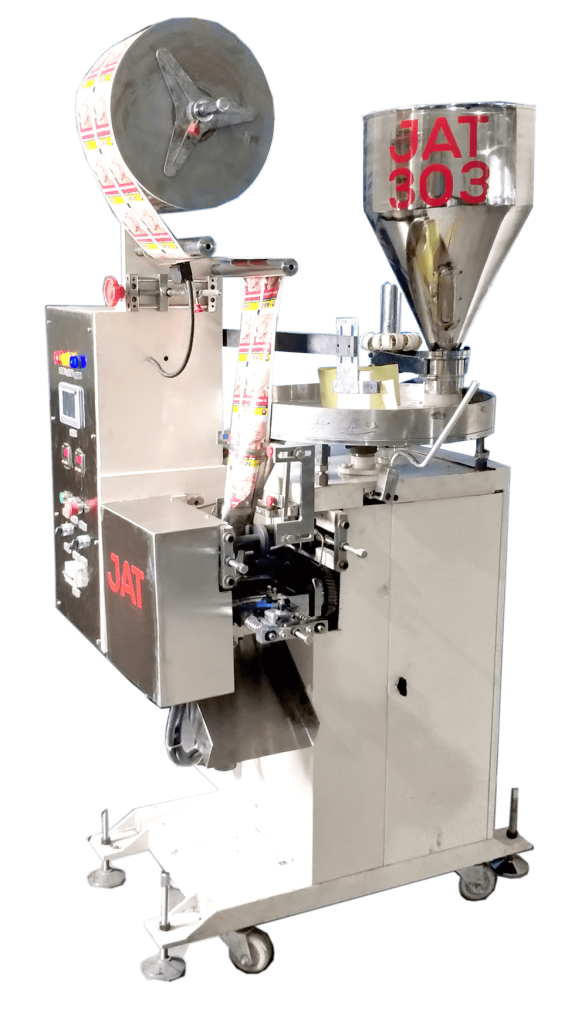
What Is a D-Motion Type Packaging Machine?
A D-Motion Type Packaging Machine is a type of Form-Fill-Seal (FFS) system that operates on continuous rotary motion rather than the intermittent (stop-start) mechanism used in conventional machines.
In a traditional packaging machine, the film stops at each station — forming, filling, sealing, cutting — and then moves to the next. Each stop-start cycle creates mechanical stress and limits throughput.
In a D-Motion system, all stations operate simultaneously in a synchronized continuous flow. The film never stops moving. This fundamental design difference is what gives D-Motion machines their speed, efficiency, and durability advantage.
How the Process Works Step by Step
- Film Loading — A roll of packaging film (PE, laminated, paper-based) is loaded onto the unwinding station
- Pouch Forming — The film is shaped into a vertical tube or pouch structure via forming collar
- Product Filling — Volumetric, auger, or multi-head weigher systems dispense the product accurately
- Heat Sealing — Continuous jaw systems seal the pouch horizontally and vertically while in motion
- Cutting & Output — Finished pouches are separated and conveyed for secondary packaging
Because every step happens simultaneously and continuously, throughput is significantly higher with no idle time between cycles.
D-Motion Type Packaging Machine Price in India (2026) — Detailed Breakdown
Prices in 2026 reflect post-GST costs including basic installation support. Prices vary based on output speed, filling mechanism, control system, and the brand’s service network.
What Drives the Price Difference?
Understanding what you are paying for in a D-Motion Type Packaging Machine prevents costly mistakes:
- Filling System: Auger fillers for powder are cheaper than multi-head combination weighers for mixed products. A servo-driven auger adds ₹1–2 lakh over a basic volumetric cup filler.
- Control System: Basic PLC with a touchscreen is standard above ₹5 lakh. Below that, machines may use older relay-based controls with limited adjustment capability.
- Sealing Jaw Quality: Continuous sealing jaws with temperature zoning produce more consistent seals but cost more to manufacture and maintain.
- Frame and Build: Stainless steel food-grade frames required for pharma and export applications add cost over mild steel frames suitable for grain packaging.
- After-Sales Network: Established manufacturers include warranty periods (typically 1 year) and service technician availability. Budget manufacturers often cannot support machines within 48 hours of breakdown — which translates directly into lost production.
Key Technical Features to Evaluate
When comparing D-Motion machines from different manufacturers, these are the specifications that matter most:
Speed and Output
The advertised speed (pouches/minute) is measured under ideal conditions with consistent product and pre-set film. Real-world efficiency is typically 75–85% of rated speed after accounting for film changes, cleaning cycles, and minor adjustments. A machine rated at 80 pouches/min will reliably deliver 60–68 pouches/min in daily production.
Film Compatibility
Not all D-Motion machines handle the same film types. Verify compatibility with:
- Multilayer laminated films (common for food)
- Metalized films (for moisture-sensitive products)
- Paper-based and compostable films (important given India’s plastic restrictions)
- Thickness range (typically 50–150 microns)
Filling System Accuracy
Filling accuracy directly affects product weight compliance and wastage. Look for:
- Volumetric cup fillers: ±2–3% accuracy, suitable for free-flowing granules
- Auger fillers: ±1–2% accuracy, best for powders
- Multi-head weighers: ±0.5–1% accuracy, for mixed or irregular products
PLC and HMI Interface
A proper PLC-controlled machine allows you to store multiple product recipes, monitor reject rates, and track production counts digitally. This data becomes essential when you scale to multiple shifts or need to meet export documentation requirements.
Maintenance Access
D-Motion machines require regular cleaning of sealing jaws, film path rollers, and filling chambers. Machines with tool-free access panels and documented PM schedules reduce downtime significantly. Ask manufacturers for Mean Time Between Failures (MTBF) data.
D-Motion vs. Other Packaging Machine Types — Honest Comparison
D-Motion vs. Conventional Intermittent FFS Machine
| Parameter | D-Motion Machine | Conventional FFS |
|---|---|---|
| Motion Type | Continuous | Stop-Start |
| Output (pouches/min) | 60–200 | 30–80 |
| Sealing Quality | Consistent (jaws in motion) | Variable (compression-based) |
| Mechanical Wear | Lower (no repeated stops) | Higher |
| Film Waste | Lower | Higher |
| Initial Cost | Higher by 20–35% | Lower |
| Long-term ROI | Better for 2+ shift operations | Suitable for single-shift, low volume |
Verdict: If you operate one shift and your volume is under 200 kg/day, a conventional FFS machine may recover costs faster. At two or more shifts or 500+ kg/day production, D-Motion’s lower downtime and higher throughput deliver better returns within 18–24 months.
Industries and Applications
D-Motion Type Packaging Machines are used across a wide range of sectors in India:
Food and Snacks — Namkeen, biscuits, fried snacks, dry fruits, noodles, instant mix products
Spices and Condiments — Ground spices, masala blends, salt, sugar, seasoning powders
Agriculture Inputs — Seeds, fertilizer granules, crop protection chemicals (granular form)
Dairy and Poultry — Feed supplements, premix powders
Pharmaceuticals — ORS sachets, protein powders, nutraceutical blends (food-grade machines with GMP compliance)
FMCG and Retail — Detergent powder, dishwash powder, washing powder
Buying Guide: How to Choose the Right D-Motion Machine
This is where most buyers make mistakes when investing in a D-Motion Type Packaging Machine. Price alone should be the last factor you evaluate — not the first.
Step 1: Define Your Required Output
Calculate your daily production requirement in kilograms or units, then reverse-engineer the pouches-per-minute speed you need. Factor in 8-hour shifts and 80% efficiency:
Required speed = (Daily output in pouches) ÷ (Shift hours × 60 × 0.80)
If you need 57,600 pouches/day in one shift: 57,600 ÷ (8 × 60 × 0.80) = 150 pouches/min. This immediately tells you which price bracket you need.
Step 2: Define Your Product Type
The filling system must match your product’s physical characteristics:
- Free-flowing granules → volumetric filler
- Fine powder or dense powder → auger filler
- Irregular pieces or mixed items → multi-head weigher
- Liquids or semi-liquids → liquid filling system (different machine category)
Step 3: Confirm Film Requirements
If your product is sensitive to moisture, oxygen, or light, you need a machine compatible with high-barrier laminated films. Verify this with the manufacturer before purchase, not after.
Step 4: Evaluate After-Sales Support
This is the most underestimated factor in machine buying decisions. Ask every manufacturer:
- Where is the nearest service center to your facility?
- What is the typical response time for a breakdown call?
- Are spare parts available off-the-shelf or made to order?
- What does the warranty cover — parts only, or parts and labor?
A machine that sits idle for 5 days waiting for a spare part costs far more than the price difference between a budget and a reputable manufacturer.
Step 5: Calculate ROI Before You Buy
A simple ROI calculation before purchase prevents regret:
- Labor savings: How many workers does this machine replace or allow you to reallocate?
- Wastage reduction: What is your current film and product wastage rate vs. the machine’s rated accuracy?
- Volume increase: How much additional revenue can you generate from higher throughput?
Most well-specified D-Motion machines for medium-scale production pay back within 14–22 months when all three factors are counted.
Common Mistakes to Avoid When Buying a Packaging Machine
Buying on price alone. A ₹3.8 lakh machine that breaks down three times in year one costs more in lost production than a ₹5.5 lakh machine with solid service support.
Not visiting the manufacturer’s facility. Always request a live demonstration with your actual product and film before signing a purchase order. Any credible manufacturer will accommodate this.
Ignoring food safety certifications. If you sell to organized retail, quick service restaurants, or export markets, your packaging line may need to meet FSSAI equipment guidelines or BRC standards. Confirm compatibility upfront.
Overlooking utility requirements. D-Motion machines require stable power supply (single or three-phase), compressed air, and sometimes nitrogen gas for modified atmosphere packaging. Ensure your facility can support these before installation.
Skipping operator training. Even a well-built machine underperforms in the hands of untrained operators. Factor training time into your launch timeline.
Related Machines Worth Knowing
As India tightens plastic use regulations (particularly for single-use items), several related machines are seeing rising demand:
Paper Bag Making Machines: For manufacturers looking to switch to paper-based carry bags and sachets. Compatible with the same filling and sealing infrastructure in many cases.
Shopping Bag Making Machines: High demand from retail packaging converters responding to state-level plastic restrictions.
Multilayer Pouch Making Machines: For producers who want in-house pouch manufacturing capability rather than sourcing pre-made pouches.
Why Jawla Advance Technology
Jawla Advance Technology has built its reputation in the Indian packaging machinery market by focusing on two things: machine reliability and post-sale responsiveness.
Their machines are engineered for long-run continuous operation, with particular attention to sealing jaw durability, film path design, and filling accuracy — the three areas where budget machines most frequently fail in real production conditions.
They offer customization for specific industry requirements, including food-grade stainless steel builds, clean-room compatible designs, and integration with multi-head weighers or liquid filling systems.
For businesses that view their packaging line as a strategic asset rather than just a cost center, Jawla Advance Technology’s combination of technical depth and service commitment makes them a strong consideration.
Frequently Asked Questions
What is the price of a D-Motion Type Packaging Machine in India in 2026? Prices range from ₹3.5 lakh for entry-level machines to ₹12 lakh and above for fully automatic high-speed systems. The right price point depends on your required output, product type, and automation needs.
How many pouches per minute can a D-Motion Type Packaging Machine produce? Entry-level models deliver 40–60 pouches per minute. Mid-range machines produce 60–90 per minute. High-end fully automatic systems can exceed 120–200 pouches per minute under optimal conditions.
What is the difference between a D-Motion and a servo packaging machine? D-Motion machines use continuous rotary motion optimized for high-speed single-format production. Servo machines use independent servo motor control at each axis, offering greater flexibility for format changes. D-Motion is better for high-volume consistent products; servo is better for businesses with multiple SKUs.
Is a D-Motion Type Packaging Machine suitable for small businesses? Yes. Entry-level D-Motion machines starting at ₹3.5 lakh are designed for small food processing units. They offer better efficiency than basic FFS machines at a manageable investment.
How much does it cost to maintain a D-Motion Type Packaging Machine? Annual maintenance costs on a well-built D-Motion machine typically range from ₹30,000 to ₹80,000 depending on usage intensity, primarily covering sealing jaw replacements, belts, and consumable parts. This is lower than intermittent FFS machines due to reduced mechanical stress.
Can D-Motion Type Packaging Machines handle paper-based packaging? Yes, modern D-Motion machines can be configured to work with paper-based and compostable films, provided the sealing system is matched to the film’s heat-sealing characteristics. Confirm this with your manufacturer if eco-friendly packaging is a requirement.
What power supply is required? Most machines in the ₹5 lakh and above range require a three-phase power connection. Entry-level machines may operate on single-phase. Compressed air (5–6 bar) is also required for pneumatic components.
How long does installation and commissioning take? Typically 2–5 working days depending on machine complexity and site readiness. Operator training is usually included in this period by reputable manufacturers.
Final Word
A D-Motion Type Packaging Machine is not just a piece of equipment — it is a production capacity decision. The right machine, sized correctly for your actual needs and supported by a responsive manufacturer, will compound returns year after year through higher throughput, lower wastage, and reduced labor dependence.
The wrong machine — chosen primarily on purchase price — will compound problems instead.
Use this guide as your framework: define your output requirements, match the machine to your product, verify service support, and calculate ROI before you commit. With those boxes checked, you are in a strong position to make a decision that scales with your business.